You might think this topic is geared toward published writers, but the best time to start marketing a locally set book is before you finish the manuscript.
Unless you live in a very small town, newspaper and other media are fairly disinterested in the release of another fiction book, even it’s set on the steps of city hall. Fiction is not news to them. On the other hand, many of the general populace are still pretty excited to be featured in a book. Not all of them, however, and some of them are still going to pooh-pooh romance – sad but true. And if your book has a lot of sex, well… The local marketing angle may or may not work for you.
All that said, here are some things you can do.
Feature local businesses and landmarks. Don’t pick the latest, trendy restaurant or the brand-new oxygen bar. Chances are, those will be long gone by the time your book is out. Go for longevity. More people will recognize local icons of business, too.
Feature well-attended, enthusiastic groups. Does your town have a greyhound rescue organization? Breed-dog lovers can be loyal readers if you feature their favorite pup in a book.
Market to gender when picking what groups to feature. Your town may be noted for its Civil War re-enactment group, but how many of those guys read romance?
Look for tie-ins. If you feature a woman-oriented business, they may be willing to promote your contest or host a book-release party. Now is the time to feel them out about it, but be diplomatic. “I was thinking of featuring your salon/jewelry store/chocolate shop in my book. Wouldn’t it be fun to have a joint party?” If you know the owner, are a good client, or have a good friend who is willing to pitch for you, you’re in better shape.
Look for communication vectors. The greyhound group that has an active Yahoo Group and a nationwide email list is better than the knitting store that puts a stack of newsletters out twice a year.
Get the idea? Great! Now get cracking on that book about the lingerie-shop owner who owns a lovable rescued greyhound and gets proposed to at your local fancy restaurant.
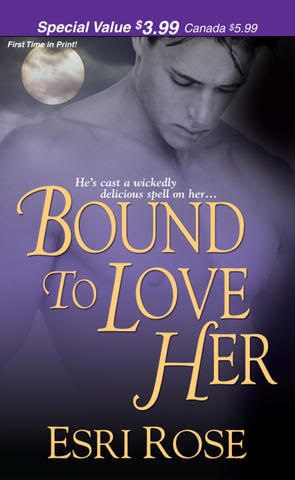
Esri Rose’s paranormal romance, Bound to Love Her, is available right now!
Bad on Paper -- Writing Good Villains, by Esri Rose
I can’t count the number of times I’ve been reading a book, enjoying it reasonably well, when all of a sudden the villain enters and the story takes off with a jet-engine roar. Villains give the protagonist a clear obstacle and the readers something to root against, whether it’s a murderous loon or the corporate soul-grinding of Bill Lumbergh in Office Space. (“Riiiiight…”)
Of course, one of the scariest villains is the implacable psychopath. We don’t know what drives him. We can’t hope to reason with him or predict his behavior. But I think that for the seriously unbalanced villain to work well, he has to be the main focus of the book; always behind the door or on the other side of the page. I’m going to focus on the non-horror-genre villains in plots that don’t involve power tools.
An interesting villain avoids the following: clichéd dialogue, no clear motivation for his/her actions, and a character so unrelievedly black, it’s the shade of cartoonist’s ink. A villain can be funny, sympathetic, even sexy. So what makes him bad? The answer is absolute selfishness. A true villain does not put anyone before his own desires -- not his mother, or the fluffy dog, or the curly-haired child. You can reason, you can plead, but a villain acts solely in his own interest. The worst villains know they should take others into account, but (sigh), it’s just not handy. The rest of us depend on the fact that most folks have altruistic tendencies – it’s an evolutionary benefit for a social species. Take that trait away and the villain is as alien as something with tentacles and six eyes.
What has cut the villain loose from the rest of humanity? It should be something the reader can comprehend, maybe even relate to. Almost as scary as meeting a villain is wondering if we could become one. Lack of love during childhood, abuse, fanatical beliefs, brainwashing, and willful ignorance are all great fodder. I find the latter particularly terrifying. If you could just explain things, you might be able to stop the bad thing from happening... Bang, you’re dead. Either the villain knew his ignorance served his purposes, or your explanation was going to cut into his favorite show.
Your villain’s motivation and goal are as important as those of your protagonists. I have to confess that I don’t find revenge a powerful motivation, in and of itself. “You messed with my father, so now I’ll mess with you.” Meh…it’s too abstract. It’s not easy to kick over the traces and be bad; you run a lot of risks. Now, if the revenge is an excuse for concrete benefits – the will is changed to enrich the villain, the dead hero’s wife can now be had – then I’m on board. Only a real slimeball justifies selfish behavior by saying the victims deserved what they got. That’s what you’re shooting for – slime. And remember, a determined villain is a scary thing. Don’t make his badness a kind of hobby. Your villain should risk terrible retribution. If the stakes aren’t serious, your reader won’t take him seriously.
Once you’ve developed the motivation of your villain, it’s time to jerk your reader around a little. We fear people who are absolutely selfish. We also fear not being able to tell who those people are. Make your protagonist question her judgment. “Is he as bad as people say? I find him kind of charming.” When the mask slips, the truth will be that much worse. It’s the creepy feeling you get while watching the neighbor scratch his head and say, “He seemed like such a nice guy.” The killer’s mom tearfully insisting, “My son would never do that.” This is also the reason traitors are so loathsome. They once believed what we believed – validated our life choices. Now they’re willing to betray us for something we can’t even comprehend. And we were fooled? Traitors make your protagonists powerfully angry – at themselves.
Finally, dialogue is key to keeping your villains real. Effective villains believe they are the good guys, and they do their best to come across that way -- otherwise, they’d have trouble doing what they do and not getting caught. If they can woo people to their point of view by sowing doubt or getting sympathy, they will. Here are three dialogue snippets from Fellseth, my villain in Bound to Love Her.
1:“Elves don’t just wither up like the Wicked Witch of the East, you know. When your people broke ground for luxury homes on my land, I knew it was going to be a long, drawn-out death.”
2: “The irony is, all the elves in existence could survive just fine off dark energy. It’s going to happen anyway. Humans can’t be denied. You could think of dark elves as a kind of evolutionary offshoot. In the end, we’ll be the only ones left.”
Sounds reasonable, even persuasive -- right up until he shows his true colors.
3: “One more outburst like that, and I’ll shoot her ear off as a friendly warning.”
One last word about villains. If you make them both selfish and sympathetic, the reader will feel conflicted about their necessary destruction. Your narrative tension will shoot through the roof, and everyone wins – except the bad guy.
Who are some of your favorite villains, either to read/view, or to write?
Getting Book Ideas or, The Barbecue Revolt – Esri Rose
I have never been asked where I get my story ideas. I have had people say, “You’re a writer? I had this idea about a bear cub who bonds to a Cabbage Patch doll. You should write about that.” Yeah, thanks.
The trick isn’t coming up with ideas per se, it’s coming up with ideas that fit within your genre, have enough conflict to carry a whole book, and fall in the ideal spectrum between something fabulously unique but not so unique that it will baffle your publisher’s marketing department.
If you’re really on the ball, it should also feature some quirky product, animal, place or cause that will get you featured in an online newsletter with ten thousand rabid fans.
The best way I’ve found to get raw material is through conversations with friends and family. Once you hear a new anecdote, news item or last night’s wacko dream, you start to riff on what ifs. The result is usually something that’s at least a little unique, because these conversations involve speculation and pushing the envelope.
Ideally, friends bring the following idea-generators to your attention: current events (which you don’t have time to read because you are writing), horrible events (which you avoid listening to because you are a sensitive artist), or workplace events (because they have real lives and you don’t). Extra-special friends will also share weird events that they heard about because they belong to specialized clubs or organizations. Those friends are gold. Not only do they know about fascinating subcultures, but they often have access to the aforementioned rabid-fan lists.
Let’s look at a conversation I had with my husband recently. We had just seen a portable fire-pit at Target, and I wondered if it was legal in our city, since it had a screen over the top. Most open-fire devices are outlawed here, including BBQ grills for renters. You can only own a grill if you’re a homeowner.
“That would start a revolution in this country,” I said. “We let politicians get away with a lot, but if they took away our grills, people would take to the streets.”
Joe agreed. “Angry men in aprons, brandishing oversized forks and skewers."
“That’d be a good political-parody book,” I mused. “The Barbecue Revolt.”
That’s a decent book idea. It’s unusual, has plenty of scope for conflict, and you could pitch it to barbecue-lover newletters—maybe even get a product-placement deal. Unfortunately, I don’t write political or social satire. Carl Hiaasen, if you’re reading this, take that idea with my blessing—just don’t forget to put my name and website in your acknowledgements. Thanks, man. We’ll have lunch.
What I currently write is elf-based romantic suspense. Let’s see how we can change this idea from political satire to something I could potentially write and sell.
Breaking the idea into its components, what do we have? First, there’s barbecue, a pastime with a history of humor and also gender division. Then there’s out-of-control fire, a natural disaster that lends itself to people with painful pasts, as well as legal problems and mysterious deaths. There’s the notion of outlawing something, which affects local politics and struggling businesses that will be hurt by the legislation. There’s revolution over an unpalatable law, and the safety of the group versus the rights of the individual.
The trick is to play with the idea. Don’t feel like you have to map to the original concept or use all the pieces.
Idea for a Paranormal Romantic-Suspense
Leeta is the only elf in four centuries to have fire-kindling powers. Unfortunately, she can’t control them. When she starts a wildfire that destroys two human houses, the fleeing owners see Leeta’s unharmed figure walking through the flames. Incidents like this put elves at risk of exposure, so Mikelor, the elves’ best tracker, is put in charge of capturing Leeta. His job? To bring her back for the ritual that will erase her gift and leave her a husk of herself. But when Mikelor meets Leeta, he begins to question his orders. Is the possibly increased safety of the group worth the sacrifice of this one elven female? When Mikelor himself is taken captive by humans, Leeta and her uncertain gift are all that can save him. Will Leeta risk herself to help the nemesis she has come to love?
Possible promotional tie-ins: You could have Leeta befriend a pet or wild animal that escaped the blaze. Put a fire pet-rescue decal in every press kit, or send a press kit/book to animal-rescue orgs like the IFAW. Hell, give ‘em some money.
You can see that it bears almost no resemblance to the original concept, but who cares? It’s an idea! Okay, I covered my genre. Let’s see how you do with your version of this idea (or give an example from scratch). And don’t worry if your tie-ins are the same or similar. Rabid-fan groups are always eager for reading material that resonates with them. There’s room for all of us.
(Word of warning: The above idea, while solid, is not so unique that I hesitated to share it. Don’t go public with a truly outstanding concept. Not that people will purposely poach it, but a published writer might think your idea is one of her own two years down the line, not remembering that she read something similar in cyberspace. Your great concept could hit the shelves in her book before you even get an agent. Ask about my embarrassing songwriting moment and I’ll share in the comments.)
Esri Rose’s first elfy book, Bound to Love Her, is available for pre-order through Amazon.com.
WetNoodlePosse.com
is about women connecting and sharing, offering support, encouragement,
information, a recommendation—or just a good belly laugh.
The opinions expressed in individual posts are those of the author,
not necessarily those of the entire Wet Noodle Posse. Copyright
of any entry belongs to the author. Entries may not be reproduced
without credit and permission.


 Look for communication vectors. The greyhound group that has an active Yahoo Group and a nationwide email list is better than the knitting store that puts a stack of newsletters out twice a year.